Smaller layers can reduce visible steps on curves, but a smooth 3D print also depends on orientation, support placement and finishing. Identify the face people will see and agree on the finish before ordering.
Why do 3D prints have visible layer lines?
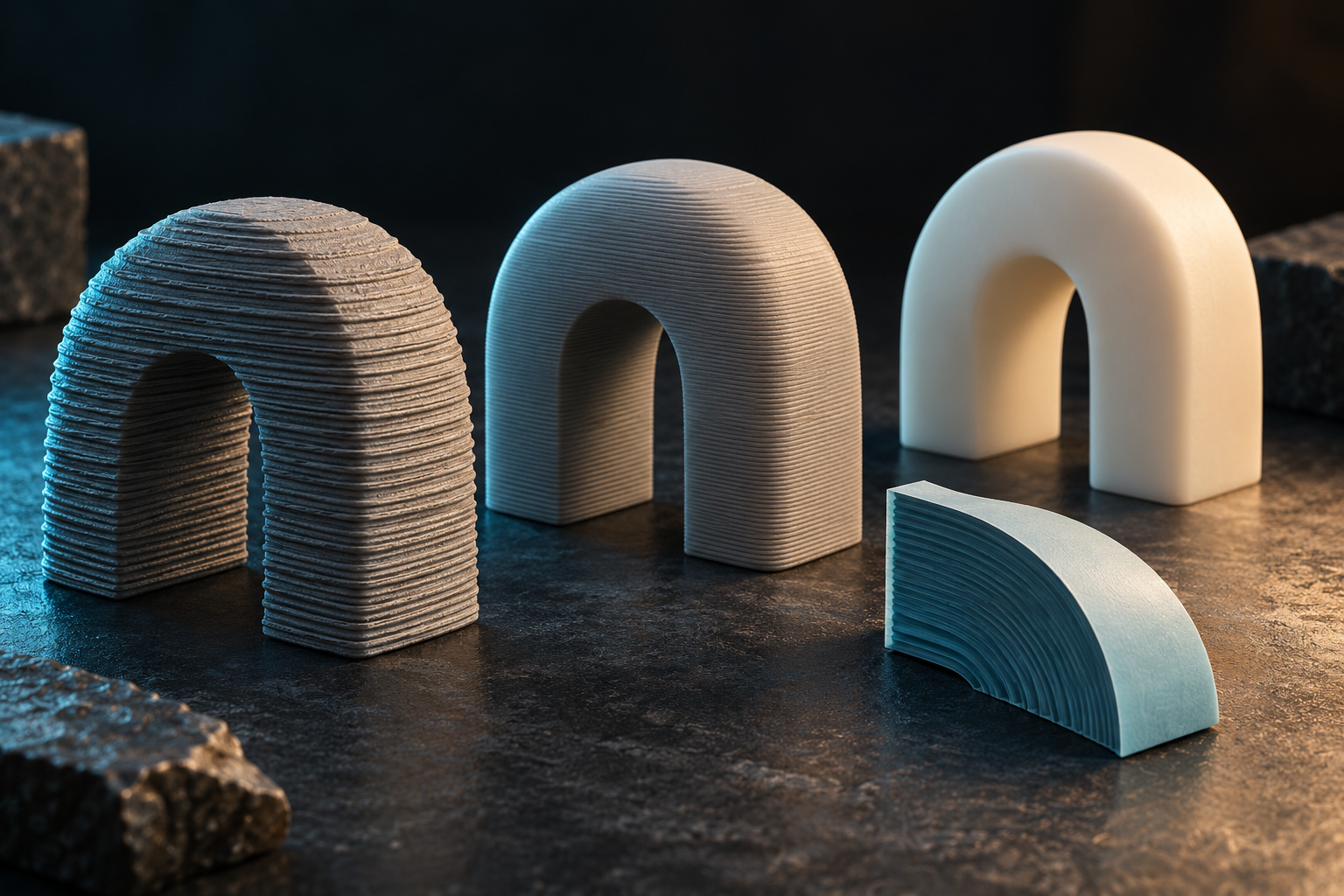
A curved or sloping surface becomes a series of small steps when built in layers. Shorter layers make those steps smaller, usually at the cost of more layers and additional print time. Vertical surfaces and flat top surfaces respond differently, so reducing layer height is not a universal fix.
This diagram compares equal overall heights. It is an explanation of the geometry, not a sample of a particular printer’s output.
How does print orientation affect surface finish?
The face against the build plate can inherit its texture. A supported underside can look different from an exposed top face. Rotating the model can move support contact to a less visible area, although it can also affect strength, fit or production time.
For a display object, highlight the presentation face. For a practical part, tell us where forces act and which surfaces must mate with another component. We can then balance appearance with function.
How can I get a smoother 3D printed surface?
A standard print may be exactly right for a workshop holder. A photographed product, presentation model or painted display can justify additional finishing. Agree on the target before printing: “smooth” means different things to different people.
| Finish goal | What to discuss |
|---|---|
| Standard printed surface | Visible layer texture and normal support cleanup. |
| Finer printed surface | Which curves or faces matter most, and the additional production time. |
| Paint-ready model | Sanding, filling and primer as a separate finishing scope. |
| Presentation piece | A reference image, color target and an agreed sample where needed. |
What should I send when requesting a smooth finish?
Send one image showing the overall look and another showing the surface you care about. Specify the viewing distance: a shelf object seen across a room has different needs from a small object held close to the eye.
If the part must fit another part, include dimensions as well as photographs. Improving appearance must not accidentally remove a functional edge, fill a small opening or change a critical fit.
How do I order a paint-ready 3D printed model?
“The front face will be visible. Layer texture on the back is fine. This is for an indoor display, and I will paint it later.” A short brief like that gives us clear priorities.
Choose the finish you want in the request form, then use the project conversation to discuss details. The right next step may be a standard print, a refined setup or a small sample.
Questions before you order
What layer height gives the best 3D print quality?
There is no single best layer height for every model. Smaller layers can make curved and sloping surfaces look finer, but add layers and production time. A flat face may benefit more from orientation or a finishing step. Show us the surface that matters.
Can you make a 3D print with no visible layer lines?
A standard print can still show layer texture. A smoother result may need a different process or extra finishing, and close-up inspection can reveal marks that are not visible from normal viewing distance. Share a reference image so we can agree on an achievable finish.
Does sanding or painting hide 3D print lines?
Surface preparation such as sanding, filling and primer can reduce visible texture before painting. Paint alone does not necessarily hide layer lines. Finishing can also soften edges or affect fit, so identify small details and functional surfaces that must be preserved.
Why does the underside look rougher than the top?
An underside printed over supports can retain contact marks after support removal. A face printed against the build plate can pick up its texture. Changing orientation can move those effects to a less visible area, while still considering strength and fit.
Plan your project
Custom 3D printing and finish review →Prepare your model for a 3D printing quote →Further reading
Manufacturer references behind this guide. Material availability and the right setup are confirmed for each project.
Prusa: variable layer height ↗Prusa: modeling with printing in mind ↗Prusa: support material ↗